






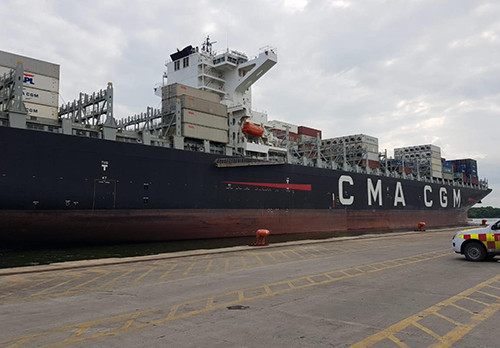
After Maersk committed to structural Suez normalization, CMA CGM reversed course exposing fundamental disagreement over Red Sea return.
The maritime industry’s tentative Red Sea reunion lasted exactly five days before cracking apart. As Maersk celebrated its January 15 announcement as a “turning point” for trans-Suez shipping, CMA CGM was quietly reaching the opposite conclusion.
On Monday, Maersk revealed it would reroute three services away from the Suez Canal and back to the Cape of Good Hope a stunning reversal that transforms Maersk’s pioneering return from industry bellwether into isolated risk exposure.
CMA’s decision, citing the “complex and uncertain international context,” delivers an unambiguous verdict on Red Sea security: even the most aggressive operators now judge the threat environment unacceptable.
That assessment carries particular weight coming from CMA CGM, the only major carrier that maintained limited Suez transits throughout the two-year crisis, moving 1.5 million containers through the canal in 2025 while rivals fled to African waters.
The divergence between Copenhagen and Marseilles reveals how completely the Somaliland development has fractured industry consensus.
Where Maersk sees tactical stabilization enabling calculated re-entry, CMA CGM identifies deteriorating conditions requiring immediate withdrawal. Both cannot be correct and within weeks, commercial shipping will discover which carrier read the strategic tea leaves accurately.
The timing exposes the volatility underlying apparent normalization.
Maersk announced its MECL service return the same day Houthi leader Abdul-Malik al-Houthi declared any Israeli presence in Somaliland a “military target.” The Danish carrier proceeded regardless, positioning the move as validation of improved regional security following Gaza’s October ceasefire.
CMA CGM’s leadership reached different conclusions during the subsequent five-day assessment window. The French liner’s FAL 1, FAL 3 and MEX services all early returnees to Suez last year will now resume Cape routing, adding 10-14 days and substantial fuel costs to each voyage. The willingness to absorb those penalties signals acute threat perception.
It seems the carriers face asymmetric exposure profiles that explain their strategic divergence.
Maersk’s MECL service connects Gulf and Indian ports to the US East Coast, transiting the Gulf of Aden but avoiding Mediterranean concentration zones. CMA CGM’s reversed services likely serve Asia-Europe routes with heavier East Mediterranean traffic, where Somaliland’s Berbera port overlooks critical shipping lanes.
Geography alone doesn’t explain the split. CMA CGM explicitly referenced the “complex international context” shipping industry code for escalating US-Iran tensions that emerged simultaneously with the Somaliland crisis. Tehran has threatened to target commercial vessels if struck by American forces, adding a second attack vector beyond Houthi maritime capabilities.
The carrier’s withdrawal suggests potential communications from war risk underwriters about coverage limitations or premium increases following threat environment reassessment.
Maersk, having committed earlier, may have locked coverage before market repricing incorporated Somaliland and Iran dynamics.
The French carrier’s retreat validates the “False Dawn” scenario, highlighted by Container News, where apparent stabilization conceals unresolved strategic competition that regenerates crisis conditions. CMA CGM demonstrated superior risk tolerance throughout the original disruption; its current withdrawal indicates even aggressive operators judge normalization premature.
For Maersk, the isolation creates both opportunity and vulnerability. If Red Sea security holds through first-quarter 2026, the Danish carrier claims competitive advantage through superior schedule reliability and reduced transit times.
If conditions deteriorate, Maersk faces the worst-case scenario analysts predicted: capital deployed for Suez operations becoming stranded when forced back to Cape routing.
The carrier maintains explicit contingency planning for MECL service reversion, emphasizing that “any alteration will remain dependent on ongoing stability.
The divergence demonstrates that maritime chokepoint control remains contested rather than resolved. Maersk’s bet assumes Gaza ceasefire removed Houthi attack justifications; CMA CGM’s withdrawal acknowledges that Israel-Somaliland recognition, combined with U.S.-Iran tensions, created alternative frameworks maintaining maritime campaign readiness regardless of Gaza status.
As Maersk’s MECL vessels transit Gulf of Aden waters this week while CMA CGM’s ships steam toward the Cape, the industry confronts an uncomfortable truth: two years and billions in rerouting costs later, the world’s major carriers still cannot agree whether the Red Sea is open for business.