






Overview
April 2025 marked a strategic escalation in maritime sanctions enforcement, as regulators transitioned from asset-focused actions to dismantling broader ownership and logistics networks. The month saw over $1.7billion in crude flows tied to newly sanctioned vessels and companies, most with links to Iranian commodity trades. Authorities intensified scrutiny of reflagging practices and ship management firms, with emerging registries like Curacao and Guyana becoming central vectors of risk. Kpler’s proprietary data highlighted these shifts in advance, flagging 63 operational and 51 management-related risk events tied to sanctioned entities.
Key takeaways
$1.7billion in sanctioned cargo moved in 2025 alone, tied to 41 vessels blacklisted in April. US, UK, and EU actions expanded to penalize ship operators and ownership networks, not just flagged vessels. Flags of convenience surged, with Panama, Barbados, and Guyana accounting for a growing share of sanctioned ships. Kpler flagged 114 high-risk behaviors across sanctioned entities before regulatory actions - reinforcing the value of predictive risk intelligence. Over 12% of the ships we identified back in February (MarineTraffic) as likely to be sanctioned in 2025 have already been sanctioned by the authorities.
Market Analysis
April 2025 saw sanctions enforcement tighten around maritime trade and strategic commodities. In the U.S., OFAC updated its maritime sanctions advisory, sharpening guidance to detect Iranian oil evasion across a growing “shadow fleet” of tankers (U.S. Department of the Treasury). The month also brought new OFAC designations targeting vessels that delivered refined petroleum to Yemen’s Houthi-controlled ports after a humanitarian exemption lapsed (U.S. Department of the Treasury). Three tankers and their owners were blacklisted for supporting the Houthis – an Iranian-aligned group known to deploy mines and drones against Red Sea shipping, threatening global navigation (U.S. Department of the Treasury). These actions underscore heightened compliance risks for shippers, as even post-conflict relief shipments (like fuel into Yemen) face scrutiny once licenses expire.
UK and EU authorities similarly advanced measures targeting illicit maritime networks and commodity flows. In late April, the UK implemented a new sanctions package that not only added tech export bans (including oil & gas exploration software) but also intensified pressure on Russia’s energy exports (Gov UK). London has now specified dozens of “shadow fleet” oil tankers for sanctions – bringing the total number of Russian-linked tankers under UK sanctions to 133, the most in Europe (Gov UK).
Brussels’ parallel 16th sanctions package (effective late February) banned EU port access and services for an additional 74 vessels involved in covert Russian oil shipments (European Council). These coordinated UK/EU steps are reshaping global shipping patterns, forcing sanctioned or high-risk ships to rely on non-Western ports and insurers. While the United Nations did not announce new sanctions in April, UN-backed embargoes (for example on arms and oil transfers in conflicts like Yemen and North Korea) continue to influence the maritime domain. Overall, regulators on both sides of the Atlantic are signaling zero tolerance for sanctions evasion at sea, tightening the compliance screws on oil, gas, grain, metals and other key trade flows going into Q2 2025. Implications for the Shipping Industry
In April 2025, 41 new vessels and 20 new companies were added to official sanctions lists. These 41 vessels were involved in over 79 million barrels of oil transfers in 2024, and more than 21 million barrels just in the first four months of the year. The 20 companies were directly or indirectly linked to more than 43 vessels that already showed serious risk signs before the sanctions — including over 63 operational risks (like turning off tracking systems, spoofing, or dark ship-to-ship transfers) and 51 management risks.
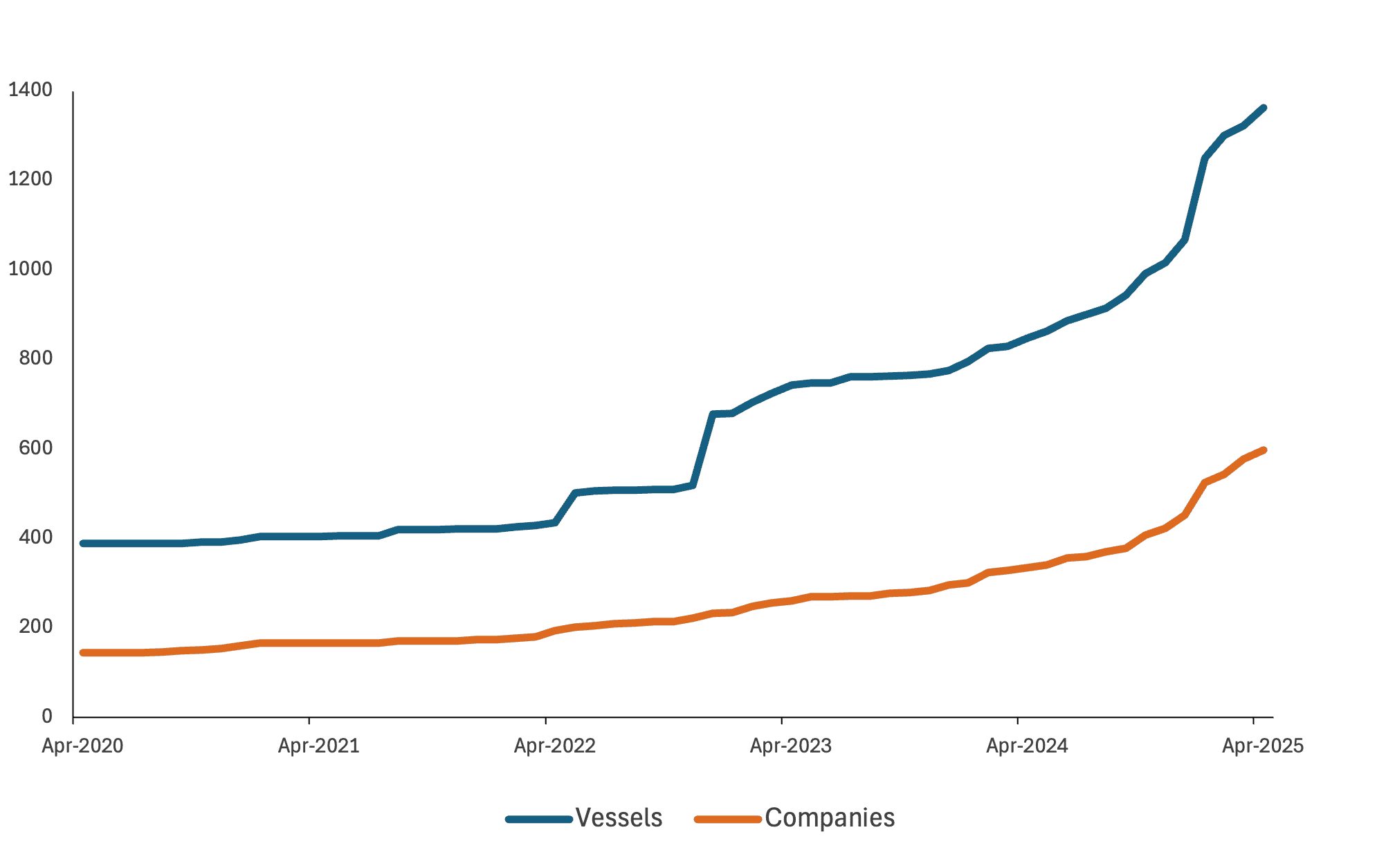
Graph 1. Sanctioned vessels and companies through the last five years (April 2020 to April 2025) - Kpler.
The graph illustrates a steady rise in the number of sanctioned vessels and companies since 2020, with a particularly sharp uptick visible in April 2025. This coincides with OFAC’s April 2025 designations targeting vessels involved in transporting Iranian-origin bitumen and HSFO, as well as the associated ship management firms, including GLORY INTERNATIONAL FZLLC and PRIME TANKERS LLC. The surge reflects a regulatory shift toward targeting operational networks - rather than just individual ships - by penalizing beneficial owners, ISM managers, and technical operators. The pronounced increase in April suggests a sweeping enforcement round, which aligns with broader Western efforts to dismantle opaque maritime networks engaged in sanctions evasion, especially those supporting Iran’s shadow exports. This escalation reinforces the mounting compliance burden on industry actors as due diligence requirements now extend beyond vessel activity to the full management and ownership chain.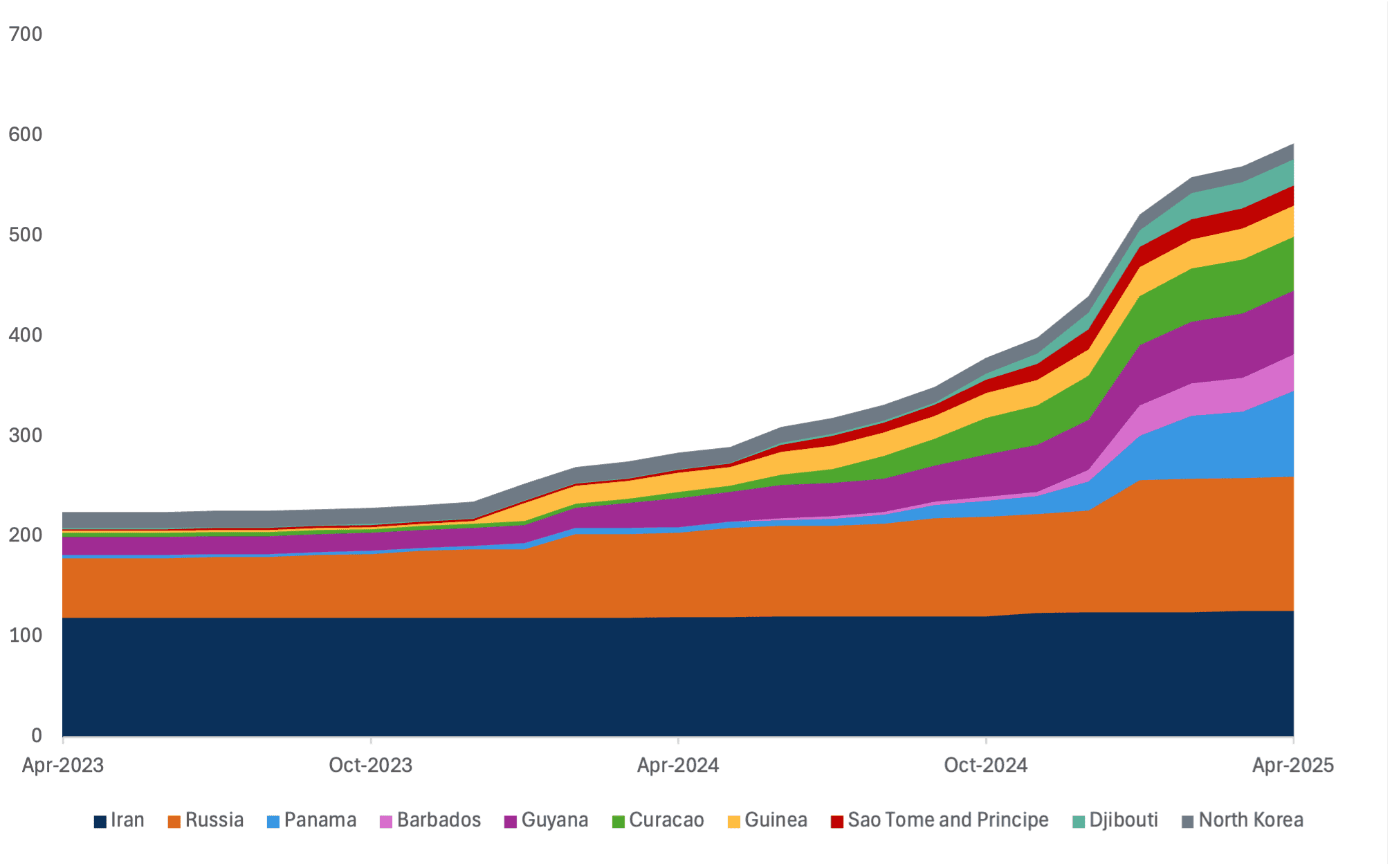
Graph 2. Sanctioned vessels per top 10 flag registry through the last two years (April 2023 to April 2025) - Kpler.
The stacked area chart illustrates a sharp increase in the number of sanctioned vessels by flag state, with a notable acceleration starting in late 2024 and peaking in April 2025. While Iran and Russia continue to account for the largest share, the most significant growth in April stems from a broader proliferation of other flags - including Panama, Barbados, Guyana, Curacao, and Sao Tome and Principe. This reflects a clear shift in evasion tactics, where sanctioned or high-risk vessels increasingly reflag to less scrutinized registries. The spike aligns with April 2025 designations by OFAC and aligned regulators, which targeted shadow fleet operators engaged in dark ship-to-ship (STS) transfers, sanctioned cargo movements (notably Iranian bitumen and Russian petroleum products), and vessels managed by blacklisted entities like GLORY INTERNATIONAL FZLLC. The diversification in flags also signals the need for enhanced due diligence, as risk exposure is no longer confined to traditionally sanctioned registries but is now diffused across a wider geopolitical landscape.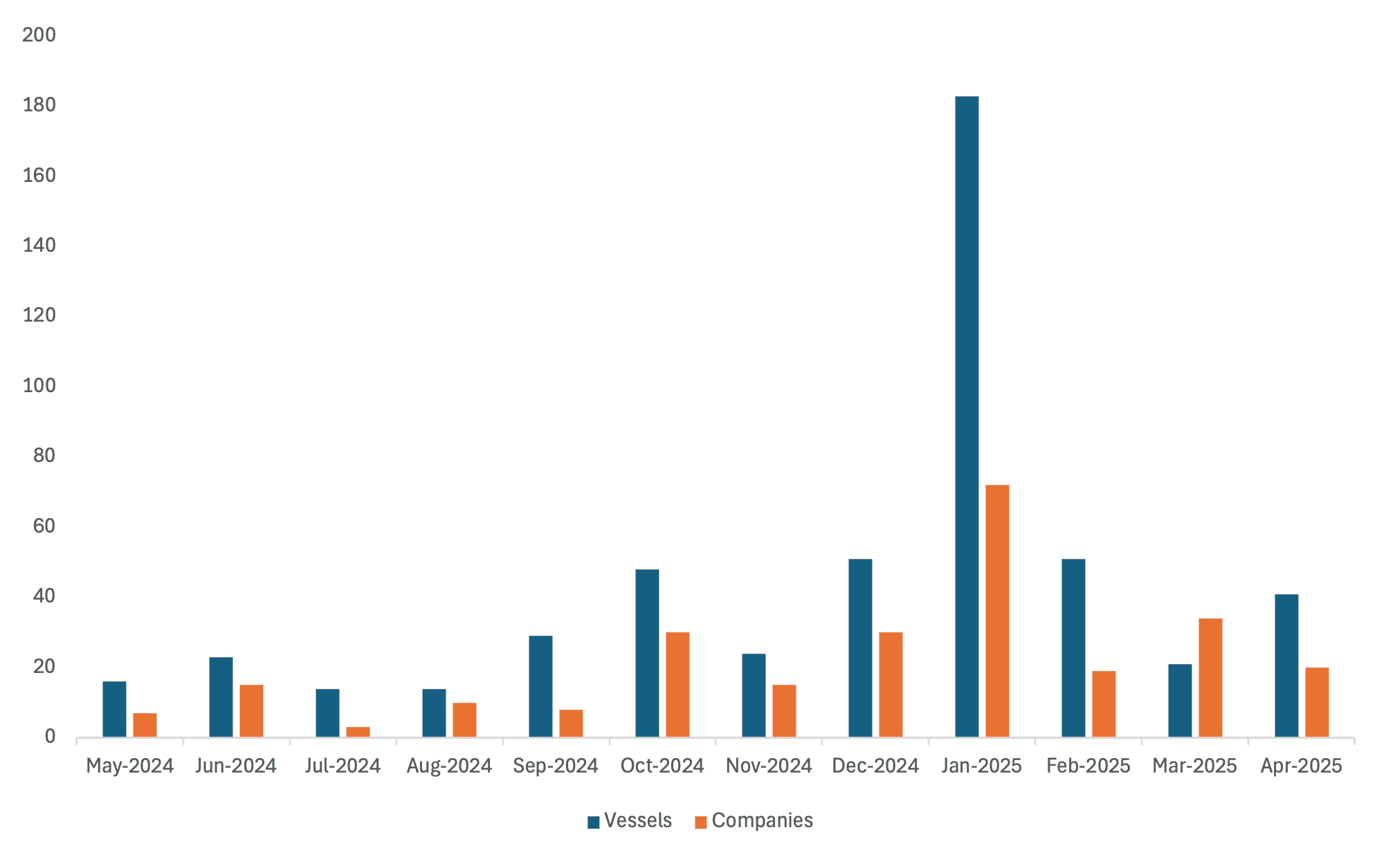
Graph 3. Total vessels and companies added to sanctions lists over the last twelve months (May 2024 to April 2025) - Kpler.
The bar chart shows monthly designations of sanctioned vessels and companies between May 2024 and April 2025. April 2025 reflects a modest resurgence in vessel designations following a relative dip in March, with over 40 vessels and around 15 companies sanctioned. This uptick aligns with OFAC’s April actions that targeted maritime actors linked to Iranian oil and bitumen exports, as well as new compliance risks related to STS transfers and AIS manipulation. While the peak of enforcement was observed in January 2025 - driven by sweeping sanctions packages related to Russian petroleum logistics and Iranian dark fleet operators - the activity in April demonstrates that regulators remain active in scrutinizing deceptive maritime practices. The sustained designation of companies, including ship managers and operators, underscores the ongoing trend of targeting the organizational structures enabling sanctions evasion, a pattern that has intensified since Q4 2024 and is expected to persist.
The 41 vessels sanctioned in April 2025 had transported over 79 million barrels of oil in 2024 and more than 21 million barrels in just the first four months of 2025. At an average Brent crude price of $83/bbl in 2024 and $82/bbl in Q1 2025, these flows equate to a total cargo value exceeding $6.5 billion for 2024 and an additional $1.7 billion so far in 2025 - bringing the combined value of sanctioned flows to approximately $8.2 billion in just over 16 months.
Conclusion
Throughout April 2025, enforcement actions by OFAC continued to target entities linked to Iranian oil and bitumen exports. Several vessels - Global Eagle, Global Maharani, and Global Genesis - remained under OFAC sanctions for their involvement in transporting sanctioned cargo, including items classified under HS code 271490 (bitumen/asphalt), with multiple voyages originating in Iran. These cargo movements are explicitly restricted under measures imposed by OFAC, the UK’s OFSI, and the EU Commission’s sanctions framework against Iran.
Moreover, there is notable evidence of increased high-risk activity through ship-to-ship (STS) operations. Global Eagle alone engaged in multiple high-risk STS transfers during April, including an STS with Global Maharani on April 22 off the coast of Mormugao, involving over 11,700 tonnes of suspected sanctioned product. While no dark STS events were recorded during this month, such frequent and high-volume STS pairings - particularly when coupled with AIS gaps - highlight elevated compliance concerns. Vessels such as Glory Star 1 and Global Genesis also exhibited AIS manipulation patterns or extended offline periods, particularly near high-risk jurisdictions such as Iran and the United Arab Emirates, suggesting potential spoofing or obfuscation of location data.
The repeated involvement of sanctioned ship management entities - most notably GLORY INTERNATIONAL FZLLC - as ISM, commercial, and technical managers across several vessels reaffirms coordinated attempts to circumvent maritime sanctions enforcement. These findings coincide with OFAC’s April 2025 listings that targeted vessels and operators engaging in deceptive practices designed to support Iranian commodity flows. While enforcement bodies did not announce additional sanctions programs during April, the expansion of existing designations to vessel operators underlines the shift in regulatory scrutiny from assets to networks.
For insurers and compliance analysts, April 2025 highlights the growing complexity of sanctions evasion and the rising risk exposure tied to vessel and company networks. With over $1.7 billion in sanctioned cargo moved in just the first four months of the year - much of it linked to Iranian and Russian flows - traditional due diligence is no longer sufficient. Kpler’s Risk & Compliance platform empowers users to stay ahead of enforcement by surfacing high-risk behaviors such as AIS spoofing, repeated dark STS activity, and ties to sanctioned management firms. As regulators broaden their focus to include entire operational ecosystems, early detection is essential to safeguarding portfolios, clients, and reputations across the maritime supply chain.