






Deal signals allied bid to rebuild fleets and counter China via Greek yards with Korean know-how.
The United States is reportedly set to sign a "trilateral shipbuilding agreement" with Korea and Greece. There is growing expectation that U.S. warships could be built in Greece using Korean shipbuilders' technology.
According to Euractiv, a European Union policy outlet, on the 19th (local time), Kimberly Guilfoyle, the U.S. ambassador to Greece, said at a forum on the 17th, "Korea, the United States, and Greece will soon sign a trilateral shipbuilding agreement," adding, "It is President Donald Trump's top priority to make agreements with allies that the United States will respect and protect."
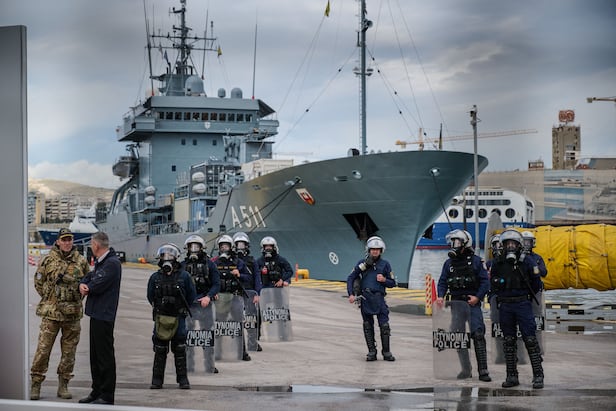
Greek police stand at an entrance as a workers' strike protest takes place at the Port of Piraeus in Athens on the 6th. /Courtesy of AFP=Yonhap
Industry watchers say the three countries are likely to cooperate in building warships. On the 18th, President Trump indicated at the credential presentation ceremony for the Greek ambassador to the United States that the new U.S. Navy frigates (escort ships) could be built in Greece.
President Trump said, "We will continue discussing rebuilding America's great shipyards and building frigates in Greece to create jobs and opportunities for both countries."
On the 13th, the United States released the "U.S. Maritime Action Plan (MAP)" to rebuild its shipbuilding industry. The idea is to build initial contract volumes at allied shipyards and then, through investment into the United States, build vessels in America. Trump's remark about building U.S. Navy warships in Greece is seen as based on this plan.
Some in the industry say Korea will play a significant role in future bilateral cooperation, noting Greece's weaker shipbuilding capabilities. Greece has small shipyards, but many assess that it lacks the capability to build warships that require advanced technology.
Kwon Hyo-jae, a researcher at Seoul National University's Department of Naval Architecture and Ocean Engineering, said, "The United States is constrained by the Jones Act from building naval vessels domestically using foreign technology and capital," adding, "Building ships in Greece with Korean capital and technology would be feasible."
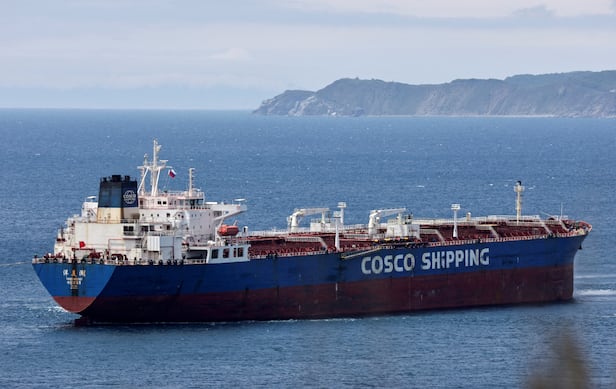
A tanker owned by the Chinese state-owned shipping company COSCO Shipping is moored off the coast near a Russian port. COSCO Shipping owns the Port of Piraeus in Greece. /Courtesy of Reuters=News1
Some also view the trilateral shipbuilding agreement as a check on China, which is expanding its influence in Greece. At Greece's Port of Piraeus, where the offices of Greek shipping companies—belonging to the world's largest shipowning nation—are located, China, which holds port operating rights, can maintain close ties with the shippers and exert influence to place orders with its own shipyards. From the U.S. perspective, tightening ties with Greece through the shipbuilding agreement is seen as a way to curb Greek shippers' orders at Chinese shipyards.
Greece's Port of Piraeus is the first major unloading port for cargoes entering the Mediterranean after passing through the Suez Canal from Asia to Europe, and China's state-owned shipping company COSCO is expanding its influence by holding 67% equity.
Based on MAP and the trilateral shipbuilding agreement, the industry believes that as the share of Greek vessels built with Korean technology at U.S. shipyards increases, the influence of Chinese shipbuilders and shipping companies in Greece could decline.
Yang Jong-seo, a senior researcher at The Export-Import Bank of Korea's Overseas Economic Research Institute, said, "From the U.S. standpoint, beyond rebuilding shipbuilding, establishing a strategic merchant fleet (state-designated vessels that transport key strategic materials such as crude oil and natural gas in peacetime and are deployed for military logistics in wartime or emergencies) is a major challenge," adding, "Shipbuilding cooperation with Korea and Greece is an option that can achieve both goals."