






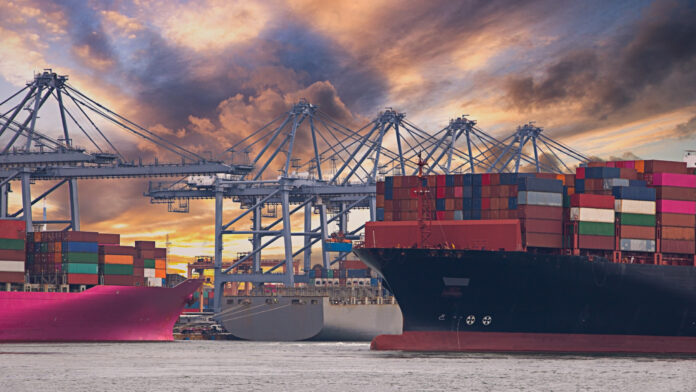
The global container shipping industry is committing record capital to newbuilds at the precise moment the geopolitical foundations of that investment are being dismantled.
This is not a paradox. It is the defining structural tension of 2025.
A US$150 billion-plus orderbook surge, headlined by COSCO’s $2.7 billion LNG fleet deal, signals an industry ordering at full throttle. Yet the same carriers placing these orders face potential US$1 billion-plus annual port fees under Washington’s Section 301 mechanism, precisely because many of those newbuilds are rolling off Chinese yards.
The business logic of cost and speed collides head-on with the geopolitical direction of travel, and the industry appears to be betting it can outrun the contradiction.
Beijing’s grip on global shipbuilding is no longer a competitive advantage it is a geopolitical instrument. China controls 53% of world shipbuilding capacity, and its military-commercial integration means every LNG carrier or ultra-large container vessel contracted with a Chinese yard carries strategic implications beyond its cargo manifest.
The White House Maritime Action Plan, with its ambitions of a 250-vessel US-flagged fleet, confronts this reality with a blunt instrument: the US accounts for just 0.1% of global shipbuilding output. No credible pathway closes that gap by 2030, making the fleet target aspirational at best and a diplomatic statement at worst.
The SHIPS Act and the Land Port Maintenance Tax framework signal genuine legislative intent. But intent and industrial capacity are different variables. The structural mismatch between Washington’s ambitions and American yards’ throughput is arguably the industry’s most underreported fault line.
Houthi interdiction and Iran-backed friction in the Red Sea corridor have reshaped global shipping geography. Port call patterns have shifted, ton-miles expanded, and insurance premiums spiked.
This is no longer an acute crisis it has become a semi-permanent structural condition baked into routing decisions, freight rate models, and port infrastructure investment across the Cape route and East African coast.
The contradiction here is sharp. Maersk and CMA CGM are testing Suez re-entry as Houthi tensions show signs of partial easing.
Simultaneously, the same carriers are committing capital to Cape route infrastructure and African port expansion bets that only pay off if the Red Sea remains unstable. Carriers cannot optimize for both scenarios simultaneously.
A full Suez reopening, combined with the industry’s 34% orderbook-to-fleet ratio, would trigger an overcapacity shock that rate models are not currently pricing.
LNG-fueled vessels now dominate the new order slate, with dual-fuel configurations presented as the pragmatic hedge against decarbonization regulation.
The logic is defensible: IMO carbon pricing timelines have slipped, methanol and ammonia bunkering infrastructure remains nascent, and carriers are hedging on transition fuels ahead of regulation — not because of it.
But the LNG orderbook locks in assets through 2029 and beyond, into an environment where accelerating methanol and ammonia adoption signals are intensifying. Carbon pricing mechanisms, even delayed, will eventually arrive.
Vessels designed around LNG economics could face regulatory headwinds well before the end of their operational lives the definition of a stranded asset in slow motion.
India’s ₹25,000 crore shipbuilding initiative represents the most significant sovereign attempt to challenge China’s maritime-industrial dominance outside Korea and Japan.
The ambition to build VLCCs and container vessels at scale is strategically coherent a nation projecting maritime power needs the yards to sustain its fleet. The execution challenge is severe. India lacks the shipyard infrastructure, skilled workforce depth, and supply chain density to deliver at competitive scale before 2030 at the earliest. The bet is real; the timeline is not.
What makes 2025’s shipping landscape distinctively dangerous is not any single risk vector it is their simultaneous activation.
Capacity is growing at 3.6% annually against demand expansion of 3% or below. Any partial Suez reopening compresses the ton-mile buffer that has sustained rates. US-China rivalry is being legislated into port fee structures that penalize the very vessels carriers need to compete. And the energy transition is advancing on a timeline that existing orderbook commitments were not structured to accommodate.
The industry is investing at record scale into a geopolitical environment that structurally threatens the commercial logic of those same investments.
The convergence of shipbuilding rivalry, Red Sea volatility, and decarbonization uncertainty creates overlapping risk vectors that no single orderbook cycle can hedge against.
The carriers placing ΘΣ$150 billion in orders today understand this. They are betting that the window between commitment and delivery is long enough to survive the contradictions.