





A massive surge in demand has seen carriers returning tonnage to US trades from Asia to meet the capacity needs but there are fears that port and inland infrastructure has not progressed since the dark days of the Covid era.
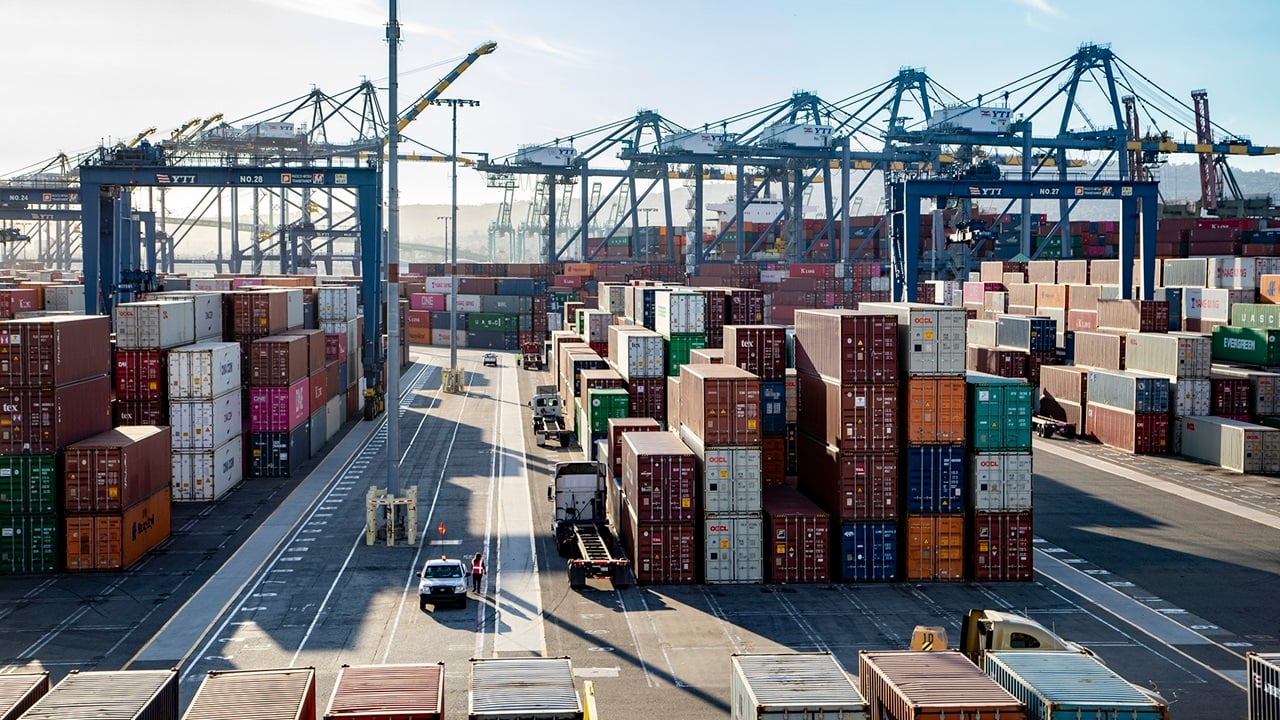
According to the JOC’s Peter Tirschwell “US West Coast ports do not respond well to cargo surges,” and he warns that shippers should expect congestion and delays in the coming months.
That surge has begun with Alphaliner reporting this week that a number of carriers, including Zim, MSC, the Premier Alliance and KMTC have launched new Pacific services or reinstated suspended loops that had seen cargo demand decline as a consequence of Washington’s tariff regime.
More than 166,000 teu will return to the Pacific with Zim the first to deploy five ships of up to 5,500 teu on its Central China Xpress loop (ZX2) from Shanghai to Los Angeles.
MSC is also reinstating its Orient service out the northern China city of Qingdao and Shanghai to Long Beach, Oakland and Portland, operating seven ships of up to 16,600 teu.
“While not having officially announced the suspension of this Transpacific loop, MSC had not advertised any further sailings after the 3 May departure of the 11,037 teu Cape Kortia ex-Busan,” said Alphaliner, adding that schedules are now showing sailings into June.
Meanwhile, the Premier Alliance, ONE, HMM and Yang Ming, have finally launched the PS5 service, which was to have started operations in February, but is now expected to launch in early June.
Six vessels of around 6,600 teu will operate out of Qingdao and Ningbo to Long Beach and Oakland with a call at Japan’s Kobe port on the westbound leg.
A 40-year absence on the Pacific for Korea Marine Transport Co (KMTC) according to Alphaliner, the carrier is, “joining as vessel provider on SeaLead Shipping’s and TS Lines’ Far East – US West Coast ‘AWC’ service next month.
The service operates out of Qingdao and Shanghai with calls in Busan and Long Beach, with six ships of between 3,000 and 10,100 teu, said Alphaliner.
SeaLead began its Pacific service in July 2024 and was joined by TS Lines two months later. KMTC will begin its operations next month and will market this loop as APX.
Speaking on a webinar organised by Hapag-Lloyd, Tirschwell reflected on a time, before Covid, when cargo moved comparatively smoothly, with a few “bumps in the road”.
Since 2020 there have been a number of events that have challenged container movements causing delays and costs in supply chains, which has resulted in a better economic environment for carriers, said Tirschwell.
Carriers’ customers, however, have seen extended transit times, which, “Means less capacity, higher pricing and now we're seeing rates shoot up into the stratosphere once again and because ships don't move very fast and the system kind of operates in slow motion these conditions are going to be with us for many, many months,” said Tirschwell.
With the return of tonnage and some new vessels into the mix Hapag-Lloyd CEO Rolf Habben Jansen questioned whether the port infrastructure in some areas is “mature enough” to meet demand.
“When I look at the next three. Four or five years then there will be some limitations in port infrastructure in quite a few markets, which means that it is good that there are a few ships extra available, because if you can't get into the port and you have to wait for a week on average, then you need an extra ship to offer the same type of service,” Jansen said.
Tirschwell took up this theme too, arguing that it takes longer to build a port than to build ships and that port infrastructure is lagging behind vessel buildings, not just in the number of ships but also their size, claiming ships “got too big too quickly” and that has led to congestion which takes capacity out of the market.He added, that “US West Coast ports typically do not respond well to cargo surges… nothing structural has changed on the US West Coast since the pandemic, meaning no massive infusion of investment, no greater information systems visibility that would facilitate smoother cargo flow in the event of a surge. Therefore, you have to assume that as the surge develops there will very likely be some slowdown of cargo movement through those ports.”