







There has been much discussion regarding disruptions in maritime shipping through the Panama Canal primarily due to the drought conditions there. Some of these dialogues have related cycles in precipitation to El Nino Southern Oscillation (ENSO). El Nino (warm phase) and its counterpart La Nina (cold Phase) have been related to reducing or enhancing precipitation respectively.
Recent ENSO outlooks from National Oceanic and Atmospheric Administration, Climate Prediction Center continues to project the beginning of La Nina from June to August 2024. As we approach the rainy season (May to December), there seems to be a high level of anticipation for increased rainfall. These expectations are in line with historical trends over the long term. Rainfall is hoped to be near normal or even above normal with the coming rainy season. If expectations do play out, the Panama Canal Authority is likely to ease restrictions in shipping through the canal. However, there is some degree of uncertainty, and actual data does not always follow historical trends. In fact, recent data show quite an interesting divergence from past records.
One such dataset is the precipitation records over Colon province. Starting in 2020, a decrease in precipitation below the 50-year average coincides with the start of La Nina event for the next three years. Historical trends would suggest an increase in precipitation during the same period. Of note, during the final year in 2022, the annual precipitation was the lowest since 1985.
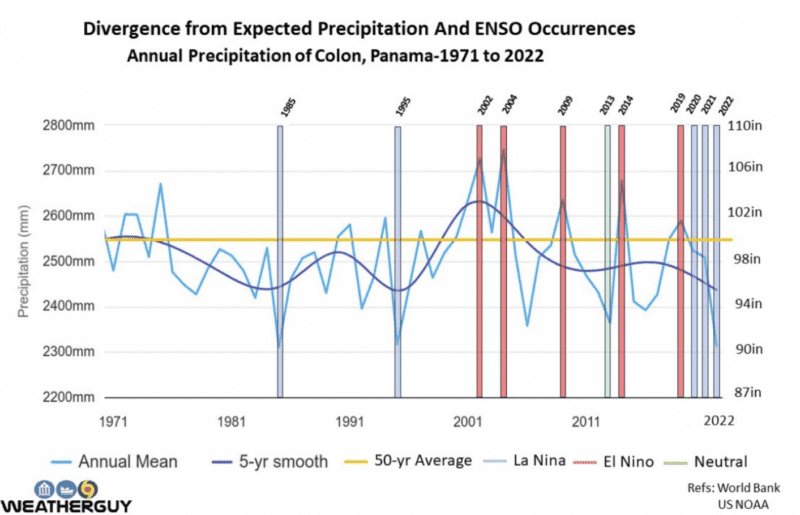
On the accompanying graph, the annual precipitation amount (millimeters (mm) on the left axis and inches (in) on the right) is charted from 1971 to 2022. The shaded columns represent ENSO events that diverged from the historical trend of actual precipitation. Note the downward trend in the five year moving average since 2020 during the La Nina event. Similarly, there were La Nina events in 1985 and 1995 where precipitation was unusually low. Inversely, in the El Nino years of 2002, 2004, 2014, and 2019 precipitation was higher than average where usual trends were lower. In 2013, when ENSO conditions were neutral, significantly less rainfall fell that year than the 50-year average.
We are all hoping for some relief in the Panama drought later this year but should not lose sight of the fact that there could be less than expected rainfall too. Regardless, the push for more climate resilient infrastructure for the canal cannot be overemphasized or come too soon.