






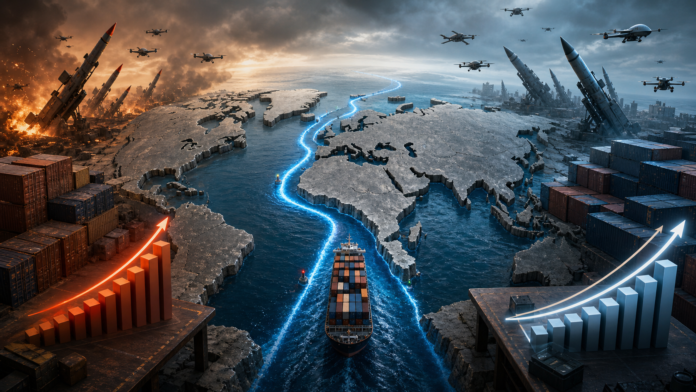
Global seaborne trade now travels 10% farther than it did in 2020. Behind that number lies six years of compounding geopolitical failure and a shipping industry paid handsomely to go the long way round.
According to new data from Clarksons Research, the average tonne of global seaborne cargo now travels 5,262 nautical miles ten percent farther than at the start of the decade.
That number is not a statistic. It is the physical footprint of disruption.
Fifty-seven percent of all tonne-mile growth between 2020 and 2026 came not from more cargo moving, but from the same cargo moving farther. The 2020s did not produce a trade boom. They produced a detour economy one in which geopolitical pressure, not commercial logic, determines where ships go.
Russia’s invasion of Ukraine fractured the Black Sea first. Grain and fertiliser flows migrated onto longer Western corridors as war-risk premiums tripled for Novorossiysk tanker transits at peak. Russian crude, excluded from G7 insurance coverage, was pushed into shadow fleet operations on extended East-of-Suez routing.
Panama followed. A historic drought in 2023 cut canal throughput by a third, adding up to 3,500 nautical miles per voyage for carriers rerouting around South America. Carriers adjusted their deployment models for contingency and never fully reverted. The shortcut had become conditional, and the industry stopped treating it as guaranteed.
The Red Sea delivered the decisive blow. The Houthi campaign that began in late 2023 reduced container capacity through Suez by 76% within months. Maersk, MSC, and CMA CGM institutionalised Cape of Good Hope routing adding 10 to 15 days per round trip and built the cost permanently into rate structures.
The ClarkSea Index, covering all commercial shipping segments, stands at US$41,435 per day year-to-date, up 65% on the prior year. Disruption, it turns out, is extremely good for business.
The Hormuz crisis completed the architecture. Iran’s selective authorization regime transiting Chinese, Turkish, and Pakistani-linked vessels while excluding Western-affiliated tonnage bifurcated the global fleet along geopolitical lines.
The Strait became a tollbooth, and the toll is denominated in flags. Combined with the Red Sea closure, Gulf energy exports now face double barrier exposure, with the Cape of Good Hope absorbing flows that once moved through two separate shortcuts on opposite sides of the Arabian Peninsula.
US-China trade strains run beneath all of it. Successive tariff escalations restructured supply chains rather than shrinking them replacing short-haul Pacific crossings with long-haul Atlantic and Indian Ocean routes for the same cargo.
American LNG terminals on the Gulf Coast, built partly as a European supply hedge against Russian gas, now service a diversified buyer portfolio on routes that barely existed a decade ago. Each reconfiguration adds miles.
Looking forward, four scenarios define the risk horizon.
First: a sustained dual-chokepoint lock, with both Hormuz and Bab el-Mandeb closed to Western tonnage simultaneously, cementing current distances as a floor rather than a peak.
Second: triple simultaneous pressure Panama, Red Sea, and Hormuz degraded in the same six-month window pushing average trade distance toward 5,900 miles and revisiting 2021 freight rate peaks.
Third: a fresh US-China tariff escalation that layers additional long-haul demand on the existing detour architecture.
Fourth: a shadow fleet regulatory collapse that displaces hundreds of illicitly operating vessels onto compliant routes, fully absorbing whatever spare capacity remains.
Each scenario operates through the same mechanism: political risk converts geographic shortcuts into conditional corridors, and the insurance market enforces the access control that no naval force could sustain indefinitely.
Volatility, as one maritime CEO recently observed, is no longer cyclical. It is the operating environment.
The ships keep sailing. They just take the long way round and every extra mile is now priced into the cost of everything.