






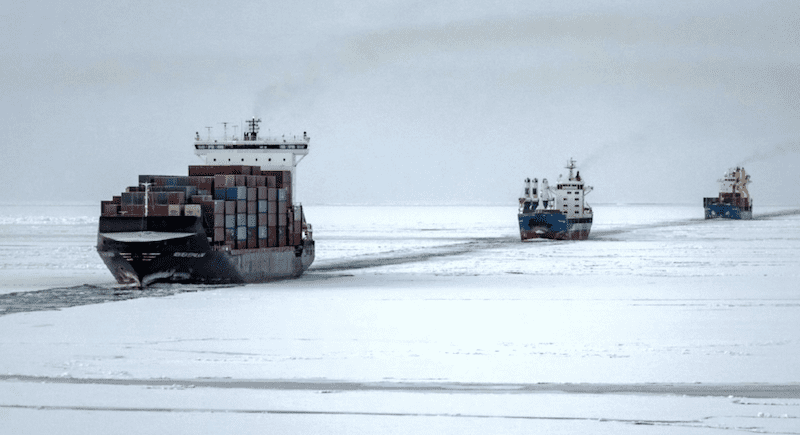
Chinese container ship NewNew Polar Bear in a convoy on the Northern Sea Route during an eastbound voyage in October 2023. Source: Rosatomflot
China significantly expanded its use of the Northern Sea Route (NSR) in 2025, completing 14 container ship voyages between Asia and Europe, up from 11 such voyages in 2024 and seven in 2023. The latest figures underscore a steady rise in Chinese-led container activity along the Arctic corridor.
The increase reflects growing confidence among Chinese operators in the seasonal Arctic route, which shortens the distance between northern China and Europe compared to traditional passages via the Suez Canal.
Shipping companies NewNew Shipping Line and Sea Legend have already signaled plans to further expand their Arctic container offerings in 2026, aiming to add sailings and improve schedule reliability during the limited summer navigation window.
The season began on July 16 with the departure of NewNew Polar Bear from Shanghai to the Russian port of Arkhangelsk. The season concluded on October 30 with a transit from Shanghai to Kaliningrad by Xin Xin Tian 2. The shipping window was around 3 weeks shorter than last year due to the early formation of sea ice in the eastern sections of the route.
Russia’s state-owned nuclear icebreaker operator Rosatomflot said the growth in container traffic translated into a record year for containerized cargo on the NSR. According to the company, container volumes reached approximately 400,000 tons in 2025, a 2.6-fold increase compared to 2024.
One of the most high-profile voyages of the season was carried out by the containership Istanbul Bridge, which completed the first-ever direct container connection between China and the United Kingdom via the Northern Sea Route. The vessel made the passage in a record 20 days, maintaining an average speed of 16.7 knots along the Arctic corridor, demonstrating the time-saving potential of the route under favorable ice and weather conditions.
Container shipping on the Northern Sea Route has long been discussed but has been slow to develop. Danish operator Maersk conducted a one-off trial voyage with the Venta Maersk in 2018, testing the commercial and operational feasibility of Arctic container transit. Despite the successful passage, Maersk and most other major Western container lines have repeatedly stated they have no plans to pursue regular container services via the NSR, citing environmental concerns, limited infrastructure, insurance challenges, and uncertain economics.
As a result, container traffic on the route has been driven primarily by Russian and Chinese interests, supported by Russia’s expanding fleet of nuclear-powered icebreakers and state-backed development of Arctic infrastructure.
Overall traffic on the Northern Sea Route also reached new highs in 2025. Authorities reported a record 103 transit voyages carrying roughly 3.2 million tons of cargo, with the vast majority consisting of crude oil, liquefied natural gas, and bulk commodities.