







When the Port of Savannah announced Vietnam as its fastest-growing trade partner this November with container volumes surging 38% over five years, the declaration carried implications far beyond a single American gateway’s success story.
It confirmed what shipping data has been signaling for months: Vietnam isn’t simply absorbing marginal “China+1” diversification. It’s executing a wholesale capture of US-bound manufacturing that’s reshaping trans-Pacific cargo flows with startling velocity.
The numbers reveal a supply chain realignment driven less by genuine industrial migration than by tariff engineering at continental scale.
Vietnam’s ports handled a record 29.9 million TEUs in 2024, a 21% surge that dramatically outpaced US import growth of 12.8%. More telling is the bilateral imbalance: Vietnam generated a US$123 billion trade surplus with the United States, translating to roughly 2.5 million containerized TEUs flowing eastward, a 15-20% year-over-year increase concentrated in textiles and electronics.
This cargo ratio mirrors China’s historical relationship with US ports, but Vietnam has achieved comparable asymmetry in a fraction of the time.
The recently announced US-Vietnam agreement reducing reciprocal tariffs to 20% with potential zero-tariff categories provides policy validation for what economic pressure already set in motion.
When faced with 25% Section 301 tariffs on Chinese goods versus substantially lower rates for Vietnamese origin, manufacturers discovered that additional handling costs and longer routing through Southeast Asia deliver compelling return on investment.
The infrastructure response exposes who believes this shift is permanent.
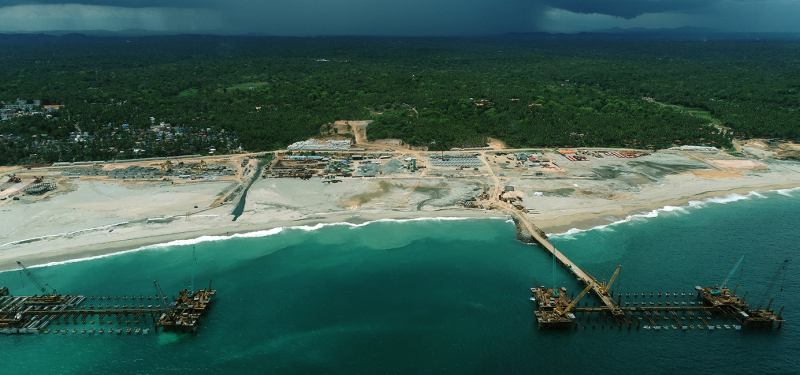
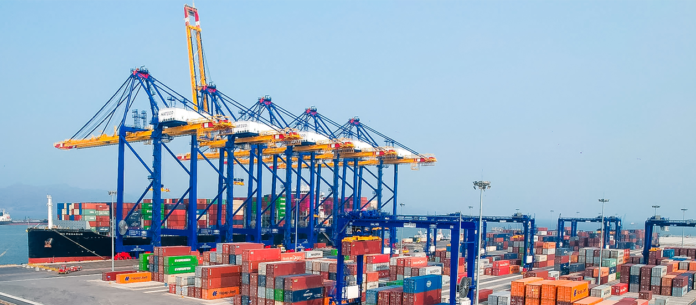
Vietnam is expanding deep-water capacity aggressively: Cai Mep’s Gemalink 2A terminal adding 1.5 million TEUs, Lach Huyen developing new berths to accommodate mega-vessels, and ports targeting 32-35 million TEUs for 2025.
These are multi-year commitments predicated on sustained export manufacturing dominance.
Meanwhile, the National Retail Federation forecasts US import volumes contracting 5.6% to 24.1 million TEUs in 2025, citing tariff uncertainty and potential enforcement actions against Vietnamese transshipment schemes.
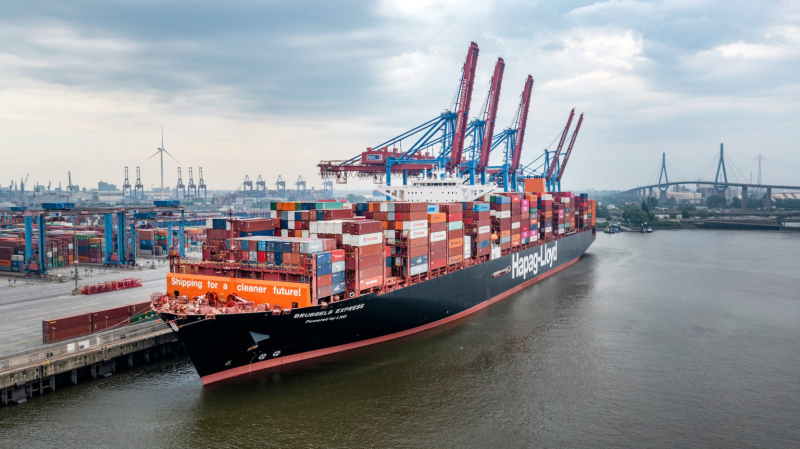
Shipping lines are voting with vessel deployment. Gemini made Savannah its first US East Coast port of call for its TP11/US1 service originating from Haiphong in November, a routing decision that bypasses traditional West Coast gateways entirely.
Yet questions about manufacturing authenticity persist.
Samsung’s US$23 billion investment in Vietnamese facilities producing over half its global smartphone output represents genuine production capacity.
But Vietnam remains heavily dependent on Chinese fabric imports for “Made in Vietnam” garments, suggesting limited vertical integration and potential origin manipulation.
The convergence of legitimate manufacturing expansion with opportunistic tariff circumvention creates a volatile foundation for the supply chain geography now taking shape.
US Customs and Border Protection has increased scrutiny of Vietnamese imports, investigating transshipment schemes where Chinese goods receive superficial processing before claiming Vietnamese origin.
The looming question for carriers, ports, and shippers isn’t whether Vietnam can sustain 20%+ annual growth it’s whether enforcement actions or shifting tariff policies will expose how much current volume represents durable industrial relocation versus arbitrage that evaporates when the rate differential narrows.
For now, American ports are responding defensively, competing aggressively for Vietnamese cargo while bracing for trade policy shocks.
Vietnam’s ports, by contrast, are building infrastructure for a future where they’ve permanently displaced China as America’s primary Pacific manufacturing supplier a bet that the economics of tariff avoidance have rewritten supply chain geography beyond any policy’s power to reverse.