
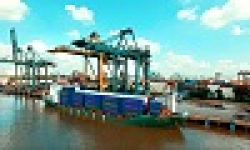




By Lori Ann LaRocco – The Port of Los Angeles was a beehive of activity in March, but details are emerging on the impact of the U.S./Israel war with Iran and the U.S. trade deal with China.
The port handled 752,520 twenty-foot equivalent units (TEUs) during the month.
“That’s a strong result coming off Lunar New Year in Asia, which led to 17 blank sailings. And even with that seasonal dip, we came in just 3 percent below last March, which was elevated as importers front-loaded cargo ahead of tariffs,” said Seroka.
On the import side, the port handled 380,733 TEUs, just 1 percent less than the same month last year. Exports reached 132,129 TEUs, 7 percent higher than March last year.
In the first quarter, the port handled 2,388,843 TEUs.
“That’s 5 percent lower than last year, which again was boosted by that pre-tariff uptick. This puts us right in line with our five-year running average and shows steady, consistent movement,” said Seroka.
Troubling indicators of consumer confidence also emerged during the monthly press conference. The port handled 239,658 empty containers, down 11 percent from last year.
“We’ll be watching this very closely because it’s a little bit lower as we expect to gear up for seasonal products coming our way,” said Seroka.
Looking ahead to April container volumes, Seroka said retailers are beginning to replenish seasonal goods, including spring and summer fashion.
“Our Port Optimizer signal shows an uptick in business in the last two weeks of April, with landings increasing and eclipsing 100,000 units in both periods. Based on that Port Optimizer and other data, I’m projecting April will land in the 800,000 TEU range—a solid start to the second quarter,” said Seroka.
These goods would be subject to Trump’s new 10 percent global tariffs, which went into effect February 24. The U.S. Court of International Trade heard a lawsuit on the legality of those tariffs on April 10. A ruling is expected in the coming weeks.
“However, with uncertainty in the Middle East and trade policy still unsettled, we’re staying ahead of it, keeping up with events, and ready to respond to whatever comes our way,” he said.
Seroka told gCaptain that higher energy prices in California, driven by the U.S./Israel war with Iran, are weighing on port stakeholders.
“It’s front of mind for everybody,” said Seroka. “When you’re talking to friends and colleagues who work here on the docks, it’s difficult. The price of diesel is now well above $7 here in Los Angeles. In some areas, we’ve seen it approaching $8. At this very moment, truckers are feeling the squeeze. More than half of the 1,100 truckers licensed to do business at this port complex are small businesses with five rigs or fewer. They are certainly feeling the pinch right now.”
In an effort to lower energy prices, the Trump administration temporarily waived the Jones Act to allow petroleum products to move between U.S. ports on foreign vessels. Seroka told gCaptain they have not seen any evidence of such movements under the waiver.
“We had 170 vessels call at the Port of Los Angeles over the past 30 days—26 U.S.-flagged, five of which were container ships,” said Seroka. “I have not seen a new influx of foreign-flagged vessels coming here and then going up to Portland or Seattle. There is no evidence.”
Another section of the California economy being hit by the war and trade tensions is agriculture.
Higher fertilizer and diesel costs are squeezing farmers, while reduced exports are further impacting their bottom line.
“With the new trade deal with China, we were told they were going to buy a bunch of soybeans. That has not happened,” said Seroka. “China, like other countries, has bypassed the United States in negotiations with third-party countries. Soybeans are now being shipped from Brazil and Argentina to China. They have been doing so for the better part of the last year.”
Seroka added that because contracts are longer-term rather than transactional, U.S. farmers will have to wait until China submits new soybean contracts for bid.
Soybeans are not the only crop affected by the global trade war.
“Almonds are moving out of Australia,” said Seroka. “Fruit, walnuts, almonds, and pistachios are big business for us here in California, and we’re feeling the brunt of these policies. Maybe it’s not just retaliatory tariffs, but a purposeful shift in sourcing to avoid the U.S.”
The White House is also working on a formal order that would increase the global tariff rate to 15%, according to an administration official.