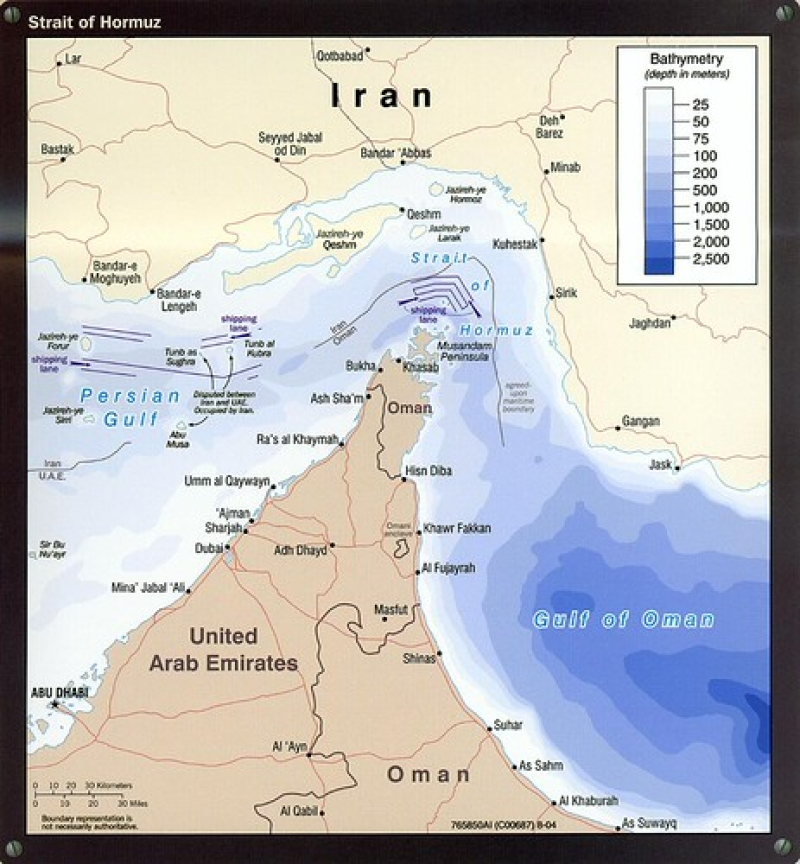







The Strait of Hormuz is no longer being disrupted. It is being governed selectively, profitably, and with growing institutional confidence.
Five structural trends emerging from the current crisis will define the operational environment for commercial shipping well beyond any ceasefire. Operators who model this as a temporary disruption are mispricing their exposure.
Western P&I clubs and London reinsurers will not return to pre-crisis frameworks for Hormuz. The mechanism is established: US or Israeli strikes trigger immediate reinsurer withdrawal, P&I cancellation notices follow within 72 hours, and commercial transit halts before Iranian enforcement is even tested. The insurance layer not the physical Strait is the operative chokepoint.
What emerges in its place are parallel structures: authorized corridor coverage for vessels operating under sanctioned access regimes, and Chinese and Middle Eastern insurers absorbing northern-lane risk. The bifurcation of the insurance market is not a temporary gap.
The selective authorization regime Chinese-linked permitted, Western-affiliated excluded has generated a powerful commercial incentive to obscure beneficial ownership. AIS manipulation, multi-flag vessel management, and beneficial ownership restructuring are migrating from sanctions evasion into standard corridor-access optimization.
The shadow fleet dynamic is no longer confined to Iranian or Russian crude. It is becoming the operational norm for any operator seeking predictable Gulf transit.
In every governance scenario, Oman is indispensable. The emerging Iranian-Omani dual-corridor framework positions Muscat as the commercial legitimizing agent for a system Iran alone cannot sustain without triggering a Western military response.
Oman’s southern-lane management anchored at Duqm and Sohar provides the insurable, commercially viable exit corridor that Gulf hydrocarbon exporters require.
But Oman’s value depends entirely on its equidistance. As both Washington and Tehran escalate their governance claims, Muscat faces a structural alignment choice it has so far avoided. Watch for Oman distancing itself from the Iranian co-management framing under US pressure.
That is the leading indicator of either a formal Western-aligned corridor partition or a governance vacuum.
Beijing has the leverage Iran’s primary economic relationship. It has the commercial interest uninterrupted Gulf hydrocarbon access. And it has demonstrated the operational capability, with COSCO resuming Gulf bookings under the IRGC clearance framework following Wang Yi’s direct call to Tehran.
In any scenario where Western authority claims fail to produce a stable access regime, China becomes the actor that stabilizes the northern lane not through military enforcement, but through economic dependency management.
The practical consequence: in a contested or vacuum scenario, Chinese naval assets may normalize a presence inside Hormuz as a commercial protection force. That would constitute a strategic milestone with implications extending well beyond the Persian Gulf.
Iran’s US$2 million per-voyage transit fee is not a crisis measure. It is a revenue architecture being built for permanence.
Even in the most adverse scenarios contested authority, governance vacuum the fee is suspended as a negotiating instrument, not abandoned. It is already being absorbed into market pricing. Its institutionalization into any post-conflict settlement is a matter of timing, not principle.
The commercialization of a global commons does not require a legal revision. It requires only that a state imposes costs, sustains them long enough for the market to absorb them, and negotiates their retention into a peace framework.
The dominant near-term trajectory is the Institutionalized Corridor: Iran generating revenue and sovereignty recognition, Oman capturing transshipment value, China securing uninterrupted hydrocarbon access.
The US military control claim has no legal anchor in Omani or Iranian territorial waters, and its enforcement options risk triggering the one scenario Washington can least afford: a governance vacuum that hands Beijing the default governance position.
The critical non-linear risk is a US-Iran kinetic incident triggered by contested authority claims. That eliminates Oman’s mediating role, collapses the corridor framework, and produces a zero-alternative geometry Hormuz sealed, Bab el-Mandeb disrupted, Cape of Good Hope saturated that no prior single-chokepoint crisis has imposed.