







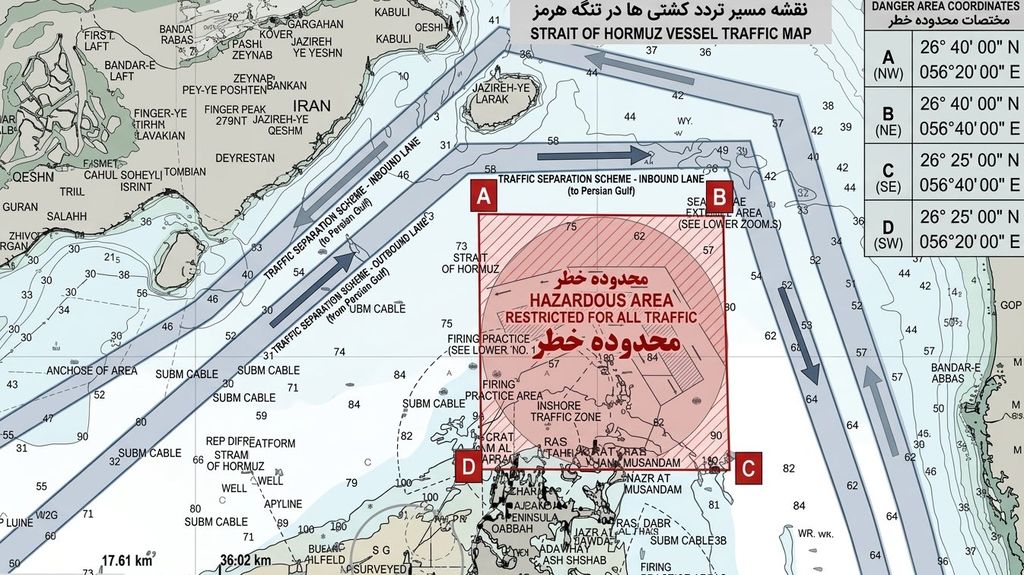
Iran's preferred control scheme runs through Iranian territorial seas, above. The reported compromise would put the inbound lane in Iranian waters and outbound traffic in Omani waters (IRGC)
The U.S. government is on board with an Iranian proposal to split control of the Strait of Hormuz with Oman, and plans to portray it as a "temporary" measure needed to restart ship movements, according to The Guardian's Patrick Wintour.
"[The] U.S. thinks the deal can be sold domestically as an interim fix," said Wintour in a social media statement, adding that other regional actors are in favor of the plan.
The general contours - reported by multiple outlets - suggest that there will be a northern inbound lane controlled by Iran and a southern outbound lane in Omani waters. Axios' Barak Ravid, who maintains close connections with the White House, repo
"I think there is a chance for a deal today or tomorrow to open the strait," said Treasury Secretary Scott Bessent in an interview Tuesday morning. Asked if Iran would be allowed to charge any fee under this scheme, Bessent said that the deal would provide for "freedom of movement," without clarifying the financial aspect. The news of an imminent deal follows just days after the White House backed away from plans for a vigorous bombing campaign targeting Iran's energy sector. Multiple Iran analysts had argued that additional bombardment would not be effective in changing Iran's negotiating position or dislodging the existing regime; in addition, Iran could be expected to retaliate with missile and drone strikes on U.S. bases and Gulf energy infrastructure, forcing the U.S. to expend increasingly scarce air defense interceptors.
"To end the confrontation the administration will be forced to lift the maritime blockade and [restore] the sanctions waiver that allowed Iranian oil exports. That reality has shaped the negotiations from the beginning," said policy commentator Danny Citrinowicz, former head of the Iran analysis desk at Israeli Defense Intelligence. "If this is ultimately the agreement that emerges, it may be the least bad option available to the Trump administration under current circumstances, especially given its clear desire to avoid another round of military escalation."
rts that the interim solution is supposed to last for 60 days, initially free of any fees for shipping, and will be followed by mine clearance in the center of the strait. This deal has been agreed by Iranian leadership, regional stakeholders and the U.S., Ravid's sources report, and an announcement is set for Wednesday.
In the long run, Iran's terms for a durable ceasefire conflict with U.S. priorities: Tehran's hard-line leadership has consistently demanded a right to exercise long-term control over the strait, to include a right to charge "service fees" for passage, and has launched attacks on neutral shipping to enforce its claims. The White House has portrayed a fee-for-passage scheme as a non-starter (if conducted under Iranian governance).
But since Sunday, the administration has signaled - as it has in previous cycles of the conflict - that a deal to reopen the strait is imminent.