






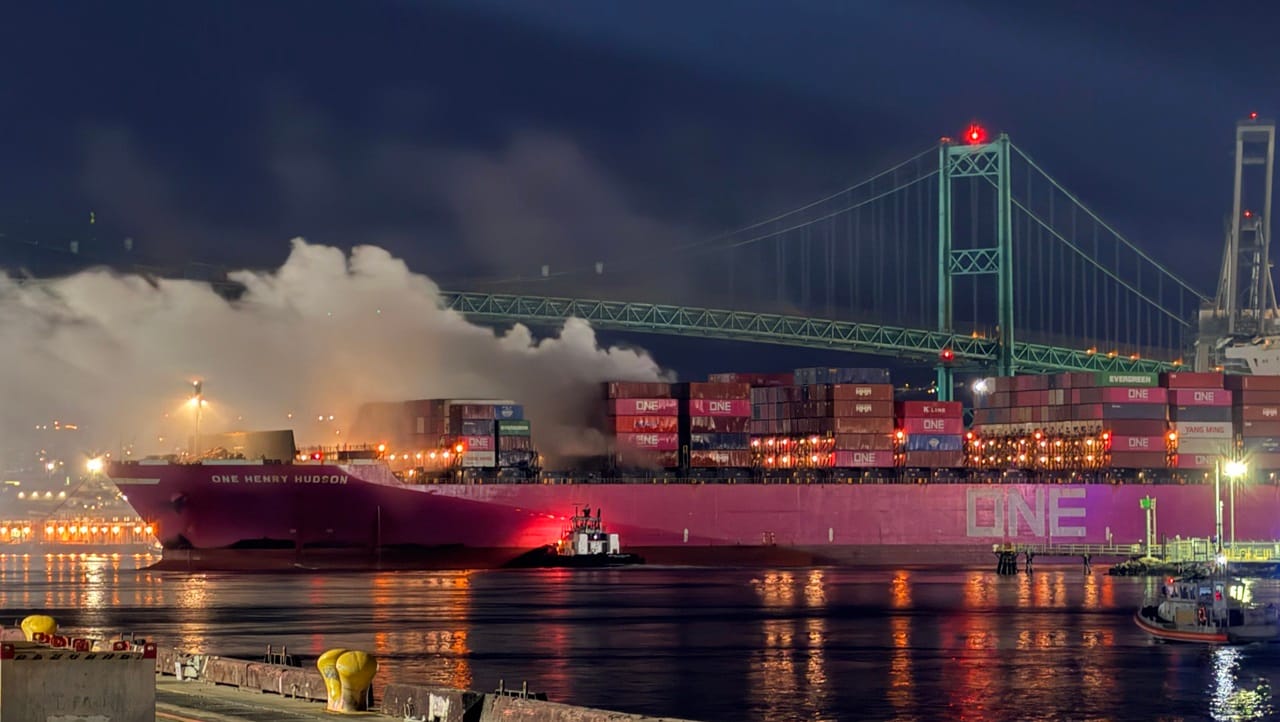
Fire remains the biggest challenge for container ship crews and the latest industry report suggests that the incidence of fires has increased over the last three years.
According to Container Ship Safety Forum (CSSF)’s latest report, 43% of all fires occur in the engine room and machinery spaces, still the majority of cases, while there is growing concern around lithium-ion battery-related cargo risks and the increasing volume of battery-powered products moving through global supply chains.
The 42-member CSSF member’s meeting recently held in Athens heard that fire is proving one of container shipping’s most stubborn safety challenges, and the latest data shows the trend is still moving in the wrong direction.
Swapnodeep (Swapan) Mondal, group MD, operations and shared services at Anglo-Eastern Ship Management and second chairman of the CSSF management board, told the largest gathering of CSSF members in its 12-year history that fire frequency among member fleets rose for the third consecutive year, and navigational incident frequency also continued to increase, while PSC inspection quality indicators weakened – even as overall safety metrics improved.
“These signals highlight the importance of early-warning, risk-sensitive key performance indicators,” said Swapan. “This combination — improving lagging indicators but weakening leading signals — is exactly why KPI relevance and structure matter.”
To put that finding in context, the CSSF measures fire frequency as the number of fire incidents per 1,000 vessel management days — the combined days that members’ vessels spend under their management.
On that basis, the fleet-wide average reached 0.15 in 2025, up from 0.14 in 2024 and 0.12 in 2023, marking a third consecutive annual increase from a low of 0.07 in 2022. While it remains below the decade’s peak of 0.17 recorded in 2019, it is the sustained, multi-year direction of travel, rather than any single year’s movement, that has focused members’ attention, as it points to a trend rather than a one-off.
Moreover, the data indicates where fires are starting through a fire-location breakdown, which tracks 13 distinct onboard locations, first introduced to CSSF reporting in 2023.
Data suggests that engine and machinery spaces accounted for approximately 43% of all fires recorded in 2025, the single largest share and consistent with 2024 when the same spaces were also the leading location.
On-deck fires, both cargo and non-cargo related, together with fires inside accommodation areas, made up much of the remaining 57%.
The concentration in engine and machinery spaces is notable because it points to a category of risk where causes such as maintenance, fuel and lubricating systems, and early detection sit largely within operators’ own control.
By way of contrast, the industry faces the separate and persistent challenge of cargo-related fires, where the root causes often lie further upstream in the supply chain.
Vessel fires are occurring, on average, every 10 days according to the International Group of P&I Clubs, so the issues around locating, identifying fire types, and dealing with fires onboard container ships is critical.
Elias Psyllos, VP at T&T Salvage, put it plainly, identifying where a fire has started on a large container ship can be almost impossible given the thousands of boxes involved.
“As reported by the International Group of P&I Clubs that use their own dataset and scope, with fires happening around every ten days, fire containment and crew training are paramount,” said Psyllos, drawing a distinction between standard seafarer training and the capabilities of professional marine firefighters.
Søren Thuen, DPA and head of fleet safety at Maersk, and first chairman of the CSSF management board, described how Maersk has revisited its catalogue of measures in response to the rise in lithium battery fires.
The presentation included design improvements beyond regulatory minimums and new work on heat-based early detection, an area that is attracting growing industry interest.
The root cause — mis-declared cargo — remains a challenge.
Lithium-ion batteries embedded in consumer goods continue to enter the container system undeclared, and enforcement remains inconsistent across jurisdictions.
Several presenters called for standardised digital cargo declarations as a necessary step forward, with regulatory change at the IMO expected to come too slowly to address the near-term risk trajectory.
"A key takeaway from this year's meeting is that the industry demonstrated that safety management works. Fatalities, injuries and several core safety indicators improved during 2025, while we are also seeing a shift towards more complex and interconnected risks, such as cybersecurity and geopolitical instability. Building resilience against these emerging risks will be one of the defining challenges for our industry over the coming decade” concluded Swapan.