






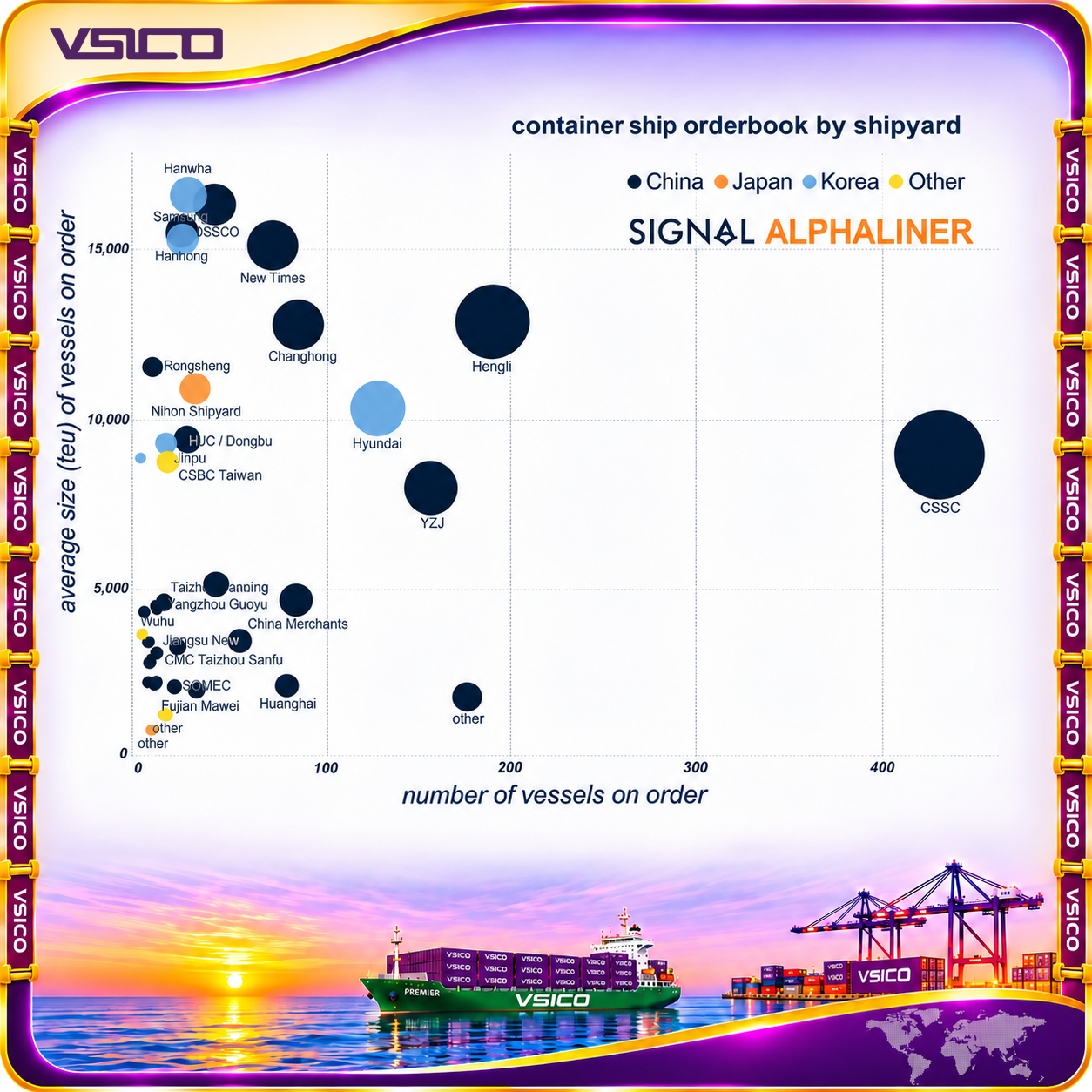
The global container ship newbuilding orderbook reveals a clear divergence among major shipbuilding centers, with China dominating in terms of the number of vessels on order.
📌 KEY HIGHLIGHTS FROM MAJOR SHIPBUILDERS:
🔹 CSSC – Leading in the Number of Vessels on Order
CSSC tops the ranking with approximately 430 vessels on order and an average capacity of nearly 9,000 TEU per vessel. The substantial gap between CSSC and other shipbuilders highlights the remarkable scale of its orderbook.
🔹 Hengli – Combining High Order Volume with Large Vessel Capacity
Hengli has approximately 190 vessels on order, with an average capacity of nearly 13,000 TEU per vessel. It stands out as one of the leading shipbuilders in both order volume and average vessel capacity.
🔹 Hanwha, Samsung, and DSIC – Among the Highest Average Vessel Capacities
These shipbuilders have average vessel capacities ranging from approximately 15,000 to 17,000 TEU. Although their order volumes are lower than those of CSSC and Hengli, their orderbooks indicate a strong focus on large container ships.
🔹 New Times and Changhong – Strong Presence in the Large Container Ship Segment
Each shipbuilder has approximately 70–90 vessels on order, with average capacities ranging from 13,000 to 15,000 TEU per vessel.
🔹 YZJ and Hyundai – Different Orderbook Structures
YZJ has approximately 160 vessels on order, with an average capacity of nearly 8,000 TEU per vessel. Hyundai, meanwhile, has approximately 130 vessels on order but a higher average capacity of more than 10,000 TEU per vessel.
💡 MARKET OUTLOOK:
Container ship newbuilding orders are heavily concentrated at Chinese shipyards, reflecting China's significant advantage in securing and executing shipbuilding contracts, while South Korea continues to demonstrate its strength in the large container ship segment. This trend highlights the divergence in capabilities and market strategies among the world's leading shipbuilding centers. It could also lead to increased carrying capacity on major shipping routes, putting downward pressure on freight rates and vessel charter rates. If fleet capacity growth outpaces cargo demand, the risk of overcapacity and supply–demand imbalances will increase, particularly if large numbers of newly built vessels are delivered within a short period. However, the actual market impact will depend on vessel delivery schedules, the volume of older ships being scrapped, and developments in global container shipping demand.
Source: Alphaliner