






A record first half has turned Beijing’s shipbuilding dominance from a forecast into a fact and left Washington’s main lever of pressure looking obsolete.
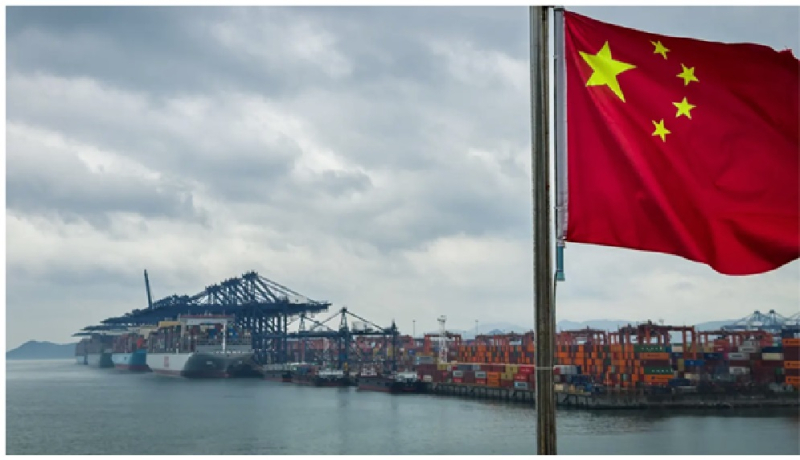
Shipowners ordered 121.06m deadweight tonnes from Chinese yards in the first half of 2026 up 173.1% year on year, and 82.3% of all tonnage ordered worldwide.
Capacity built ahead of demand has been filled ahead of schedule
The central question about China’s expansion had been whether it was speculative.
Dozens of dormant yards were reactivated before the orders existed to fill them, and the obvious risk was idle steel.
That risk has closed: the berths are full, and a projected 80% increase in Chinese capacity by 2027 no longer looks like an overbuild. What was pre-positioning is now simply position.
The marginal ship is now almost entirely Chinese
The most revealing figure is the gap between two shares.
China holds 71.2% of the world’s existing orderbook but took 82.3% of new orders the first number describes the past, the second the direction of travel.
That leaves about 17.7% of global ordering for South Korea, Japan, Europe and everyone else combined, so owners who want to diversify by country of build increasingly cannot, at any price.
The scarce commodity is no longer steel it is a delivery slot
China’s orderbook stands at 363.25m dwt, up 54.9%. Against half-year deliveries of 36.5m dwt 62.2% of world completions that implies roughly five years of committed output.
When yards are sold out that far ahead, the binding constraint is queue position, and queue positions are allocated at the builder’s discretion. Where the largest builders sit close to the state, scheduling becomes an instrument of policy.
The concentration is broad as well as deep: more than 80% of orders in bulkers, container ships and tankers, and for a third year more than 68% of alternative-fuel orders, which turns IMO emissions deadlines into demand pointed at Chinese berths.
Growth is spreading beyond the state champions, too Hengli Heavy Industry has committed US$1.94bn to new capacity and Titan Wind Energy has entered tanker building, blunting sanctions tools calibrated against CSSC.
A truce that accelerated what it was meant to slow
The record was set inside a ceasefire. Washington suspended its Section 301 port fees for a year in November 2025, and much of the 173% surge looks like arbitrage of that window: owners signed while the meter was off.
Tellingly, the second quarter outpaced the first rather than tailing off before expiry owners do not treat reimposition as credible.
A fee that has become a tax
That leaves the US Maritime Action Plan facing a problem of arithmetic. With 71.2% of the orderbook Chinese-built, the fleet calling at American ports through 2032 will be overwhelmingly Chinese-built whatever policy says.
A per-kilogram levy therefore works as a permanent import tax and revenue line, not a deterrent carriers already treat the lower tiers as operating cost.
US pressure on South Korean yards to deliver hulls rather than memoranda, meanwhile, pulls scarce allied capacity toward naval and Jones Act work, away from the commercial market China already leads. Naval hulls are bought at the price of commercial share.
Leverage that peaked before it was used
The escalation logic has inverted. Reimposing penalties would threaten a five-year backlog in which Western owners, not Chinese builders, hold the exposed position.
American leverage over this industry peaked before the truce and is unlikely to return: projections that China would hold 70–75% of global shipbuilding by 2030 have already been overtaken on an ordering basis.