






Reliance on a single strategic maritime route can trigger ripple effects across global shipping operations, delivery schedules, and logistics costs. As geopolitical tensions raise the risk of maritime disruptions in the Strait of Hormuz, diversifying transport corridors has become increasingly important to maintaining supply chain resilience.
So, beyond the Strait of Hormuz, which alternative gateways could help keep global cargo moving?
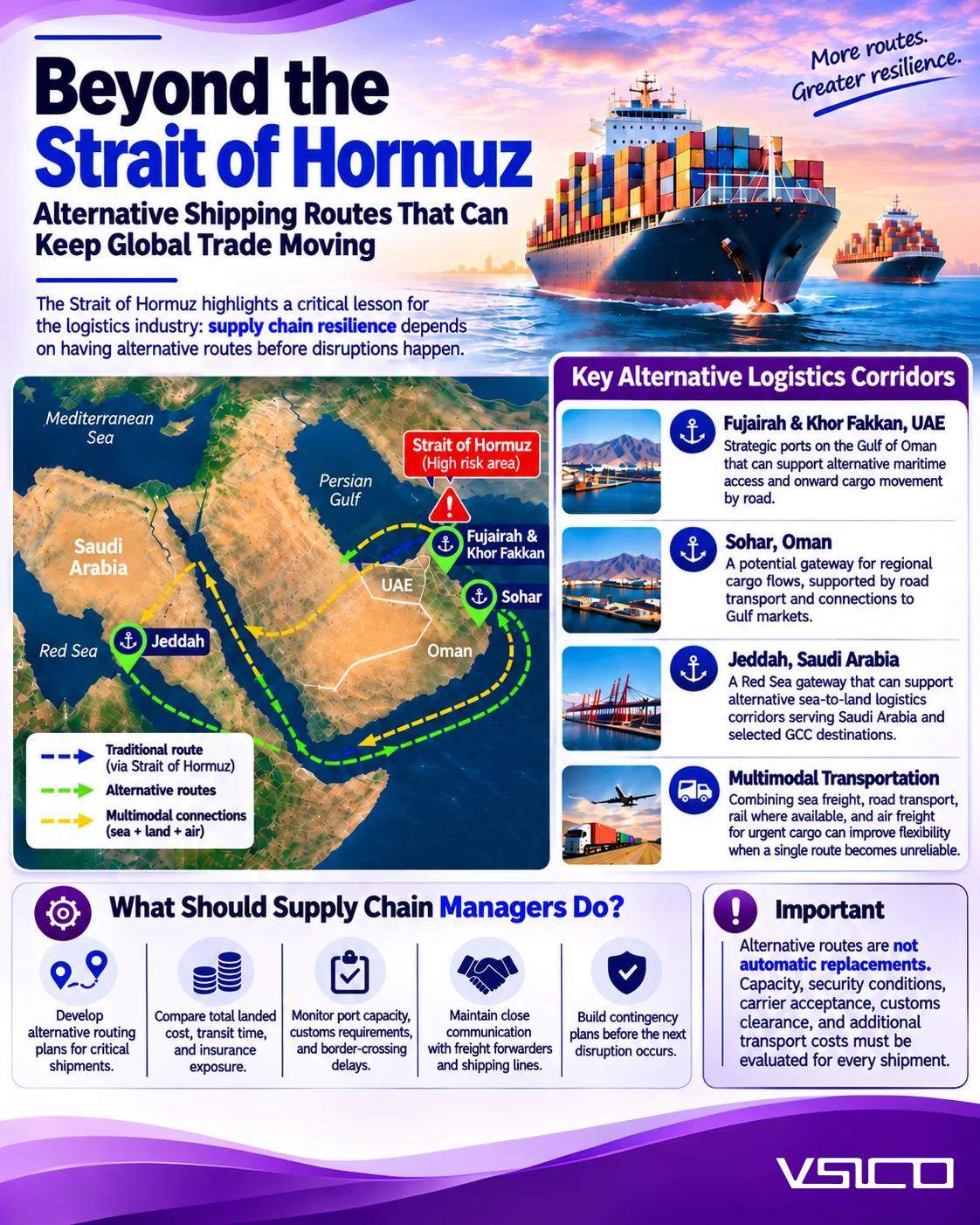
📍 Fujairah and Khor Fakkan (UAE): Strategic ports located on the Gulf of Oman, providing alternative maritime access and reducing dependence on routes through the Strait of Hormuz.
📍 Sohar (Oman): A potential regional cargo transit hub, connecting maritime transport with road networks and markets across the Gulf region.
📍 Jeddah (Saudi Arabia): A Red Sea gateway supporting the development of integrated sea–land logistics corridors serving Saudi Arabia and selected GCC markets.
📍 Multimodal Transport: Combining sea, road, rail, and air transport to maintain cargo flows, particularly for time-sensitive shipments.
📋 REROUTING CARGO: WHAT SHOULD BUSINESSES CONSIDER?
🔹 Develop alternative routing strategies for critical trade lanes.
🔹 Assess total logistics costs, transit times, and insurance premiums for each option.
🔹 Monitor port handling capacity, customs clearance conditions, and connectivity at border crossings and transshipment hubs.
🔹 Maintain close coordination with shipping lines, freight forwarders, and logistics service providers.
🔹 Proactively establish contingency plans before supply chain disruptions occur.
In logistics management, competitive advantage is not simply about finding the shortest route, but also about maintaining operational continuity when that route is no longer viable.
⚓️ A resilient supply chain needs more than one route.
Source: Islam Shaheen