







Designing warehouses based on inventory characteristics is a key factor in helping businesses optimize storage space, streamline material flows, and enhance operational efficiency. Selecting the right warehouse layout for different product categories, inventory turnover rates, and inbound–outbound processes not only reduces logistics costs but also improves handling productivity, inventory accuracy, and distribution service quality.
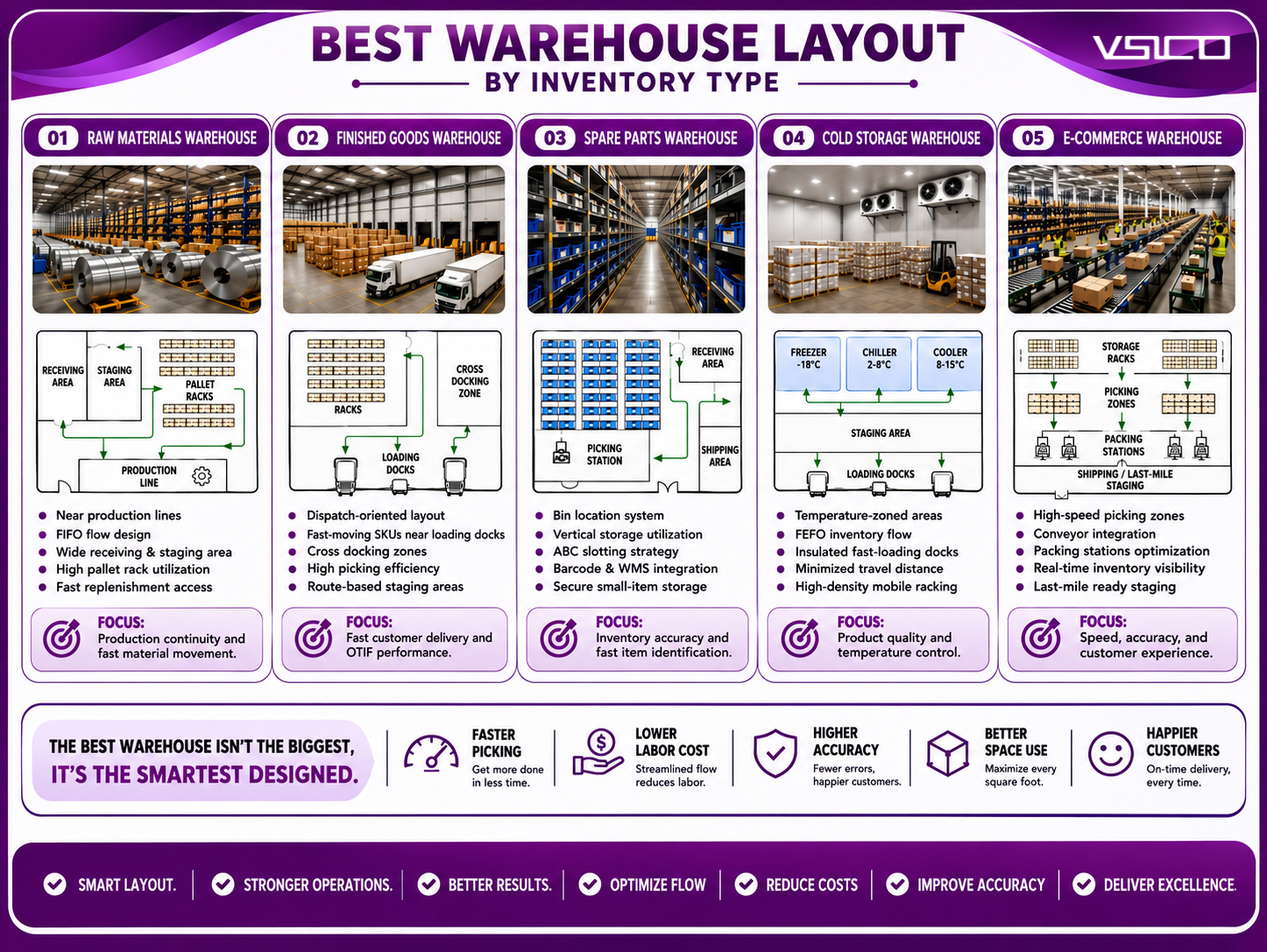
🔹 Raw Materials Warehouse: Prioritizes proximity to production lines, optimizes inbound and outbound material flows, and ensures continuous material replenishment. Implements the First-In, First-Out (FIFO) principle to manage inventory turnover, expands receiving and staging areas, and utilizes pallet racking systems.
🔹 Finished Goods Warehouse: Focuses on outbound efficiency by positioning fast-moving products near dispatch areas and optimizing loading operations. Applies cross-docking to minimize storage time and warehousing costs, shorten delivery lead times, and improve On-Time In-Full (OTIF) delivery performance.
🔹 Spare Parts Warehouse: Maximizes vertical storage space, systematically categorizes inventory, and integrates barcode technology with Warehouse Management Systems (WMS) to improve inventory accuracy, enable faster item retrieval, and minimize losses.
🔹 Cold Storage Warehouse: Establishes temperature-controlled zones, maintains strict quality control, and applies the First-Expired, First-Out (FEFO) principle to prioritize products with the earliest expiration dates. Optimizes material flows and storage density to preserve product quality while reducing energy costs.
🔹 E-commerce Warehouse: Optimizes picking and packing areas while integrating conveyor systems to accommodate high order-processing volumes and enable real-time inventory management.
💡 KEY TAKEAWAY:
The most efficient warehouse is not necessarily the largest, but the one designed most intelligently—tailored to inventory characteristics and optimized for the entire flow of goods, from receiving and storage to distribution.
Source: LinkedIn